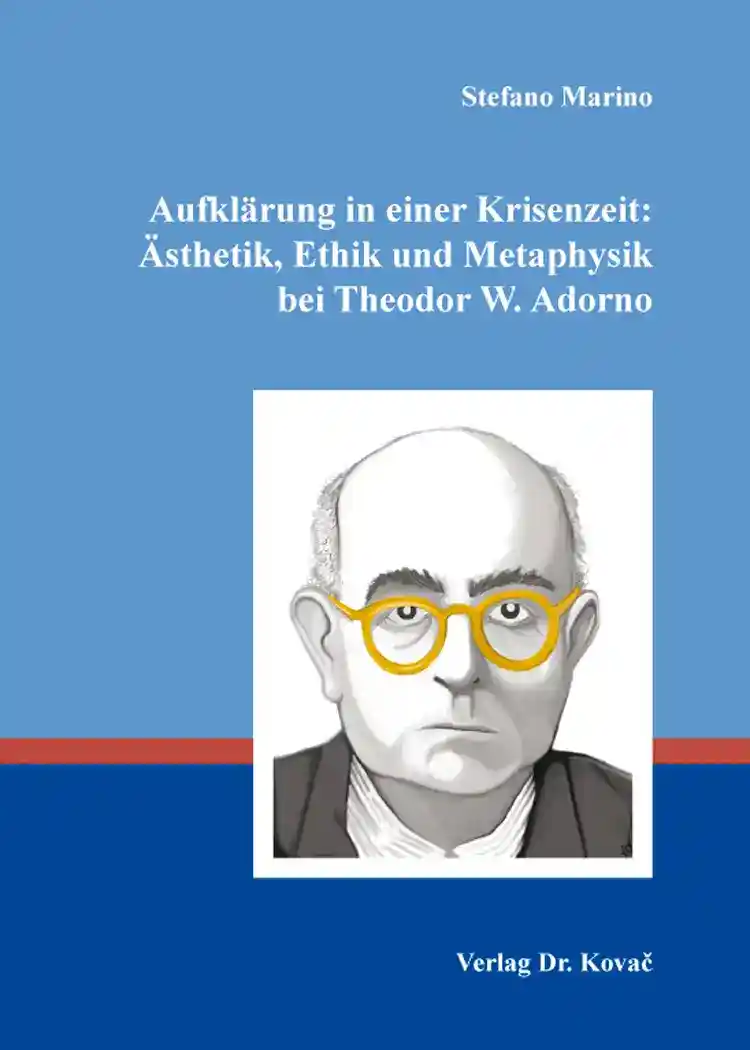
Stefano MarinoAufklärung in einer Krisenzeit: Ästhetik, Ethik und Metaphysik bei Theodor W. Adorno
 Mit Unterstützung des Segretariato Europeo per le Pubblicazioni Scientifiche (SEPS)
BOETHIANA – Forschungsergebnisse zur Philosophie, volume 111
Hamburg 2015, 166 pages
ISBN 978-3-8300-7287-4 (print) |ISBN 978-3-339-07287-0 (eBook)
About this book deutschenglish
What distinguishes the philosophy and, more in general, the culture of our age is to a wide extent a sense of uncertainty and temporariness, uneasiness and decline, confusion and sometimes even devastation, desperation and tragedy. Should one indicate a single word capable to summarize and express such a general and peculiar condition of our time, then it would probably be the word “Crisisâ€. Indeed, even taking into consideration philosophical works only, it is apparent that during the 20th century, hundreds of books and articles were dedicated to such subjects as the “Crisis of reasonâ€, the “Crisis of civilizationâ€, the “Crisis of cultureâ€, the “Crisis of artâ€, the “Crisis of spiritualityâ€, the “Crisis of mankindâ€, the “Crisis of historyâ€, the “Crisis of traditionsâ€, the “Crisis of morality†and the “Crisis of religionâ€. By the way, this does not apply only to the 20th century but to the 21st as well. A simple look at the newspapers, watching the news on television, or making a quick search on the internet will reveal “Crisis†has become a main issue of our time. None of the leading characters of the 20th-century philosophy and culture could avoid facing such a decisive challenge as the one presented by the critical situation of our age. Among them a particular mention goes to Theodor Wiesengrund Adorno: according to his work, the crisis of modernity was so widespread and profound that “after Auschwitzâ€, not only the faith in progress of mankind, but also the simple right to live had been questioned. However, even if it is possible and indeed correct to interpret Adorno’s philosophy as one of several expressions of the 20th-century “philosophy of crisis†or “negative thinkingâ€, it must be noted that a decisive role in his thought was played by the concept of enlightenment. In contrast to the majority of 20th-century “philosophers of the crisisâ€, Adorno never considered enlightenment, reason and modern culture as such as responsible for the crisis into which mankind had fallen. Instead he accused what may be called “false enlightenment†of having produced this critical situation: namely, the distorted form assumed by enlightenment throughout human history due to its entwinement with power, dominion, and violence. This book offers an interpretation of Adorno’s thought starting from the basic question concerning the “dialectic of enlightenmentâ€, and then analyzing such fundamental issues as nature and history, morality and knowledge, aesthetics and metaphysics. The basic idea underlying the entire development of this book is that Adorno’s thought was precisely characterized by an interesting and indeed undeniable tendency to entwine different aspects of philosophy, such as knowledge theory with ethics, or aesthetics with metaphysics.Kontaktmöglichkeit
Mit Unterstützung des Segretariato Europeo per le Pubblicazioni Scientifiche (SEPS)

Die Übersetzung dieses Buches wurde mit Unterstützung des SEPS – Segretariato Europeo per le Pubblicazioni Scientifiche erstellt.
Keywords
ÄsthetikAufklärungAuschwitzDialektikEthikFrankfurter SchuleGesellschaftstheorieKritische TheorieKunstphilosophieKunsttheorieMetaphysikPhilosophiePhilosphie des 20. JahrhundertsSoziologieTheodor W. AdornoIhr Werk im Verlag Dr. Kovač
Möchten Sie Ihre wissenschaftliche Arbeit publizieren? Erfahren Sie mehr über unsere günstigen Konditionen und unseren Service für Autorinnen und Autoren.