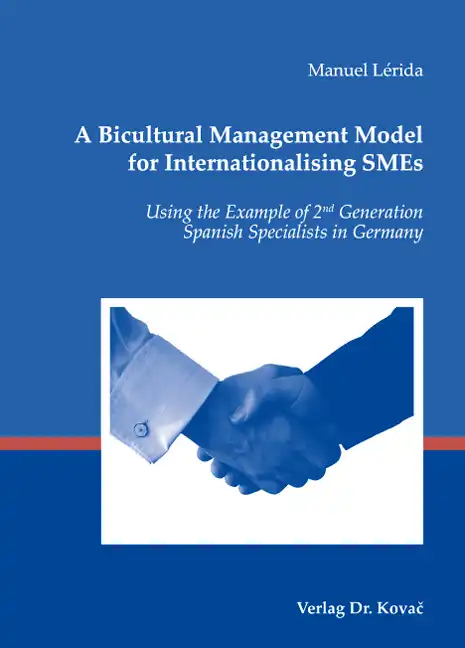
Manuel LéridaA Bicultural Management Model for Internationalising SMEs
Using the Example of 2nd Generation Spanish Specialists in Germany
Strategisches Management, Band 56
Hamburg 2008, 350 Seiten
ISBN 978-3-8300-3781-1 (Print) |ISBN 978-3-339-03781-7 (eBook)
Zum Inhalt
Objective of this book is to demonstrate a new strategic approach; the use of 2nd generation bicultural experts as competitive advantage for internationalising SMEs. The approach described in this book is, on one hand, based on the example of 2nd generation Spanish experts in Germany and on the other hand, concentrates on the example of Spanish small and medium sized enterprises, which want to expand their businesses into the German markets.
Bicultural individuals represent a special kind of human resource. Growing up and enjoying the education and lifestyle of the host country and at the same time retaining the native cultural identity and language. Thus, combining the bicultural skills, expertise and knowledge with the requirements of internationalising SMEs to overcome the obstacles on foreign markets leads to this new competitive bicultural management model.
The study presented in this book uses both, primary and secondary data. The data involved qualitative research and examinations of current empirical research in the literature review. In the stage of the literature review, the theoretical perspectives of Spanish SMEs and their marketing are evaluated in order to identify business requirements that Spanish SMEs need to improve their businesses on German markets. Records and information about Spanish migration and culture and its elements are examined. Further, research that identifies the advantages of being bicultural is evaluated. In addition, the topic of model building in management is examined that lead to the introduction of an initial bicultural management role model. Finally, the current gaps in knowledge are presented. The literature review draws the main academic and personal influences that formed the preferences to investigate how biculturalism forms competitive advantages for internationalising SMEs.
The examinations highlight the need to continue an in-depth investigation of these subjects in order to clarify the interrelations between internationalisation and biculturalism. Thus, this research concentrates on the qualitative research methods of applying the focus group method and in-depth interviews.
By combining the findings of the respective stages, the contribution to knowledge is the development of a management model for internationalising SMEs to improve their competitive advantages by using the qualifications of 2nd generation bicultural experts.
Kontaktmöglichkeit
Schlagworte
2nd generation migrantsBetriebswirtschaftslehreBicultural expertsBiculturalismIntercultural CompetenceInternational businessInternationales ManagementInternationalisation strategyInternationalisierungStrategisches ManagementIhr Werk im Verlag Dr. Kovač
Möchten Sie Ihre wissenschaftliche Arbeit publizieren? Erfahren Sie mehr über unsere günstigen Konditionen und unseren Service für Autorinnen und Autoren.